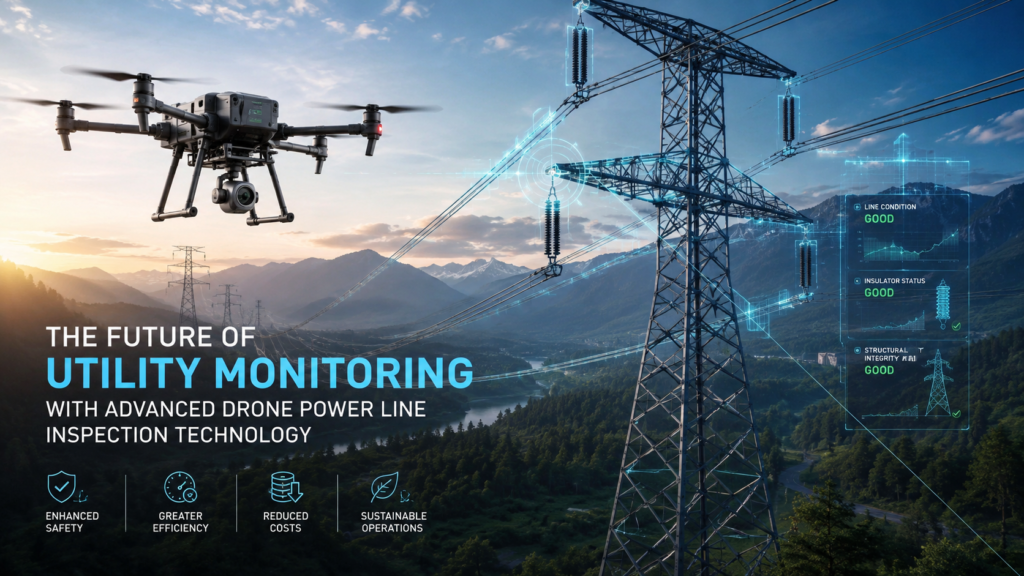
The utility industry is undergoing a major transformation as companies adopt smarter, faster, and safer methods for monitoring critical infrastructure. One of the most significant innovations driving this shift is drone power line inspection technology. Utilities around the world are now using drones equipped with AI, thermal imaging, LiDAR, and autonomous flight systems to inspect transmission lines, substations, and utility corridors with unmatched precision.
Traditional inspection methods often involve climbing towers, sending workers into dangerous environments, or using helicopters to monitor miles of power lines. These methods are expensive, time-consuming, and risky. Advanced drone systems are changing that reality by delivering real-time data, predictive analytics, and automated inspection capabilities that improve operational efficiency and safety. Industry reports and recent technology developments show that AI-powered UAV systems are becoming the future standard for utility infrastructure monitoring.
The Growing Need for Smarter Utility Monitoring
Power grids are expanding rapidly as energy demand increases worldwide. Aging infrastructure, climate-related challenges, and rising maintenance costs are forcing utility companies to modernize their inspection processes. Manual inspections can no longer keep pace with the complexity and scale of modern utility networks.
This is where drone power line inspection solutions are proving essential. Drones can inspect long stretches of transmission lines in a fraction of the time required by traditional crews. They can also reach remote or hazardous locations without putting human workers at risk.
Modern drones equipped with thermal sensors and high-resolution imaging systems can identify:
- Corroded components
- Damaged insulators
- Loose connectors
- Vegetation encroachment
- Hotspots and overheating
- Structural defects in towers
These capabilities help utilities detect issues before they become critical failures. AI-powered analysis further improves detection accuracy and speeds up maintenance decisions.
How Advanced Drone Technology is Changing the Industry
The latest generation of utility drones is far more sophisticated than earlier UAV systems. Today’s platforms feature autonomous navigation, obstacle avoidance, AI-driven analytics, and beyond visual line of sight (BVLOS) operations.
Advanced drone systems can now:
- Automatically follow transmission lines
- Capture synchronized thermal and RGB imagery
- Generate 3D models using LiDAR
- Perform real-time defect analysis
- Upload inspection data directly to cloud platforms
Autonomous capabilities are especially important for large-scale inspections. Research in drone automation demonstrates how drones can now intelligently track power lines while maintaining optimal camera positioning for accurate inspections.
This automation reduces human error and ensures consistent inspection quality across large utility networks.
AI and Predictive Maintenance in Utility Monitoring
Artificial intelligence is becoming one of the biggest drivers behind the future of utility monitoring. AI systems analyze thousands of drone-captured images in real time, identifying defects that may be difficult for human inspectors to detect manually.
Machine learning algorithms can recognize patterns such as:
- Cracks in insulators
- Rust and corrosion
- Vegetation risks
- Cable sagging
- Thermal anomalies
AI-powered predictive maintenance allows utilities to fix issues before outages occur. Instead of reacting to failures, companies can proactively schedule repairs and reduce downtime.
Modern AI systems also improve inspection scalability. Utilities can monitor hundreds of miles of power infrastructure simultaneously while reducing operational costs.
The integration of AI with drone technology is helping utilities move toward fully intelligent grid management systems.
Safety Benefits of Drone Power Line Inspection
Safety remains one of the most important advantages of using drones in utility inspections. Traditional inspections expose workers to dangerous conditions such as high-voltage environments, difficult terrain, and harsh weather.
With drone power line inspection, inspectors can remain safely on the ground while drones collect detailed inspection data from energized lines. This significantly reduces the need for tower climbing and helicopter-based inspections.
Modern drones are designed to operate in challenging weather conditions and can perform inspections without interrupting power operations. Some advanced systems are even capable of autonomous flight in strong winds and extreme temperatures.
By minimizing human exposure to hazardous environments, utilities can improve workplace safety while reducing liability and operational risks.
The Role of Thermal Imaging and LiDAR
Thermal imaging and LiDAR technologies are becoming standard tools in advanced drone inspections.
Thermal Imaging
Thermal cameras help utilities identify overheating components before failures occur. Hotspots in connectors, transformers, and conductors often indicate electrical resistance or equipment degradation.
Thermal inspections help utilities:
- Prevent power outages
- Detect overloaded equipment
- Improve energy efficiency
- Reduce fire risks
LiDAR Technology
LiDAR creates precise 3D models of utility infrastructure and surrounding environments. This technology is especially useful for vegetation management and clearance analysis.
LiDAR-based inspections can accurately measure:
- Distance between trees and power lines
- Tower structure integrity
- Terrain mapping
- Line sagging and positioning
Recent advancements in LiDAR-based drone inspections are enabling highly accurate real-time monitoring of overhead power lines.
Why Drones are Becoming Essential for Construction and Infrastructure
The same technologies used in utility monitoring are also transforming the construction industry. Many companies now consider drones an essential part of project planning, surveying, and infrastructure inspection.
In fact, utility contractors and infrastructure companies increasingly search for the best drone for construction because modern drones support multiple operational needs, including:
- Site mapping
- Progress monitoring
- Asset inspection
- Safety assessments
- Surveying and modeling
Construction companies working on power infrastructure projects benefit from drones that can handle both utility inspections and construction monitoring tasks. Advanced UAV platforms equipped with AI and LiDAR provide significant value across multiple industries.
The Future of Autonomous Utility Monitoring
The future of utility monitoring will likely involve fully autonomous inspection ecosystems powered by drones, AI, IoT sensors, and cloud-based analytics platforms.
Emerging technologies are expected to deliver:
- Fully autonomous inspection flights
- Continuous real-time monitoring
- AI-generated maintenance reports
- Smart grid integration
- Automated emergency response systems
As drone technology evolves, utility companies will gain faster access to accurate data while reducing inspection costs and improving grid reliability.
The combination of AI, advanced imaging, autonomous navigation, and predictive analytics is redefining infrastructure management across the energy sector. Experts and industry leaders increasingly recognize drone-based inspection systems as the future of utility operations.
Conclusion
Advanced drone power line inspection technology is revolutionizing utility monitoring by making inspections safer, faster, and more intelligent. Drones equipped with AI, thermal imaging, and LiDAR are helping utilities detect problems early, reduce maintenance costs, and improve operational efficiency.
As power grids continue to expand and infrastructure ages, autonomous drone systems will become increasingly critical for maintaining reliable utility services. The integration of AI-powered analytics and real-time monitoring will further enhance decision-making and predictive maintenance strategies.
At the same time, industries beyond utilities are embracing UAV innovation, with many businesses searching for the best drone for construction to support infrastructure development and monitoring projects. The future clearly points toward smarter, autonomous, and data-driven inspection systems that will redefine how utilities manage critical assets for years to come.