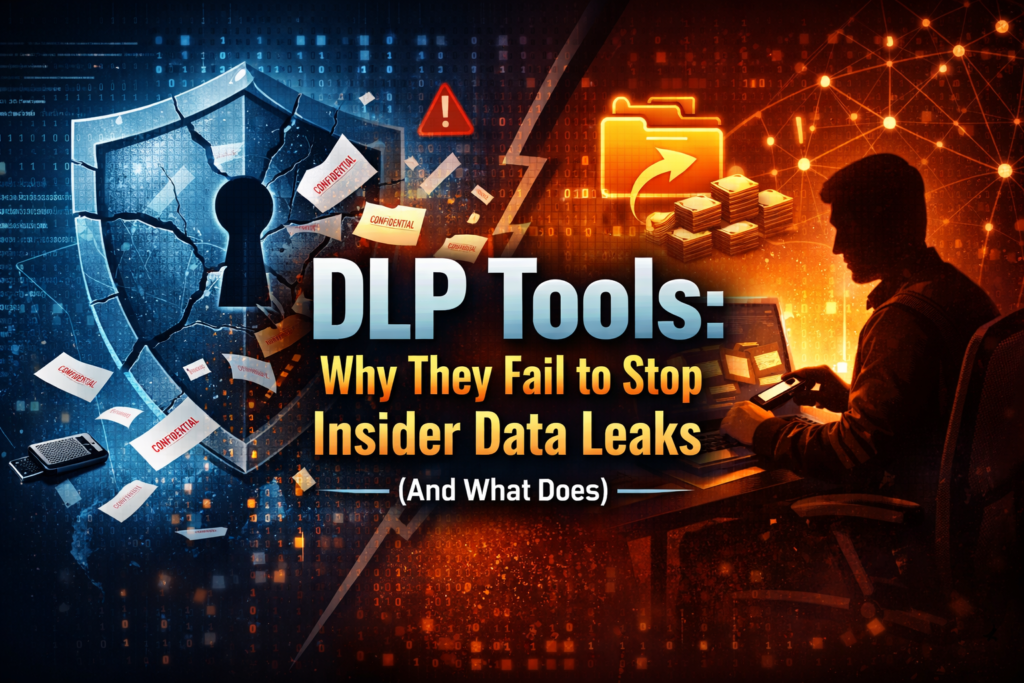
Data loss prevention tools have been the security industry’s go-to solution for stopping sensitive information from walking out the door. Yet here’s the uncomfortable truth: most organizations running DLP still experience insider data leaks. The technology that promised to be a digital fortress has become more like a screen door. After years of watching companies invest heavily in DLP solutions only to suffer breaches from their own employees, the pattern is clear. Traditional DLP fails because it was designed for a different era, one where data lived in predictable places and threats came from outside. The modern insider threat operates differently, exploiting the very gaps that rule-based systems cannot see. Understanding why DLP tools fail to stop insider data leaks reveals what actually works to protect your most valuable information.
The Traditional DLP Paradox: Why Rules Aren’t Enough
DLP systems operate on a fundamental assumption: if you can define what sensitive data looks like and where it should go, you can stop it from leaving. This logic sounds reasonable until you watch it crumble against real-world insider behavior.
The Rigidity of Pattern Matching and Regex
Traditional DLP relies heavily on pattern matching to identify sensitive content. Credit card numbers follow specific formats. Social Security numbers have predictable structures. The system scans for these patterns and blocks or alerts when detected. The problem? Insiders know these rules too. A determined employee can simply add spaces, change formats, or break data across multiple files. Regex patterns that worked yesterday become useless when someone screenshots a spreadsheet instead of downloading it. The rigidity that makes DLP deployable also makes it predictable and exploitable.
The High Cost of False Positives and Alert Fatigue
Security teams drown in DLP alerts. A typical enterprise deployment generates thousands of notifications daily, with false positive rates often exceeding 90 percent. When your system cries wolf constantly, analysts stop investigating. Real incidents hide in the noise. Organizations face an impossible choice: tune policies so tightly that legitimate work gets blocked, or loosen them enough that actual threats slip through. Neither option protects the business.
Common Blind Spots in Legacy DLP Architecture
The architecture of traditional DLP creates inherent vulnerabilities that insiders exploit daily. These systems were built for a perimeter that no longer exists.
Shadow IT and the Rise of Unmanaged Cloud Apps
Employees use an average of 36 cloud services for work, and IT knows about maybe a third of them. DLP agents monitor sanctioned applications while sensitive data flows freely through personal Dropbox accounts, WhatsApp messages, and browser-based tools. The modern workforce routes around security controls instinctively, not maliciously, but because those controls slow them down. Every unmonitored channel becomes a potential exfiltration path.
Encryption and Data Obfuscation Workarounds
Insiders quickly learn that encrypted files bypass content inspection. A simple password-protected ZIP archive defeats most DLP scanning. Renaming file extensions, embedding data in images, or using personal VPNs creates blind spots that traditional tools cannot address. The same encryption that protects legitimate business communications provides perfect cover for data theft.
The Human Element: Why Insiders Outpace Static Policies
Technical controls fail because insider threats are fundamentally human problems. Static policies cannot adapt to dynamic human behavior.
Intent vs. Accident: The Complexity of Insider Behavior
Not every insider leak is malicious. Research suggests that negligent insiders cause more incidents than deliberate ones. An employee emails a client list to their personal account to work from home. A contractor uploads sensitive files to the wrong shared drive. DLP treats all violations identically, unable to distinguish between a tired employee making a mistake and a disgruntled worker preparing to jump to a competitor. This blindness to intent creates both security gaps and morale problems.
The ‘Low and Slow’ Exfiltration Strategy
Sophisticated insiders avoid triggering thresholds by taking small amounts of data over extended periods. Instead of downloading the entire customer database, they export fifty records daily for six months. DLP systems watching for bulk transfers miss this gradual extraction entirely. By the time anyone notices, the damage is done and the trail is cold.
Shifting to Data Detection and Response (DDR)
Effective insider threat protection requires moving beyond prevention to detection and response. DDR approaches assume breaches will occur and focus on rapid identification.
Leveraging User and Entity Behavior Analytics (UEBA)
UEBA establishes behavioral baselines for each user and flags anomalies. When an accountant who normally accesses three systems suddenly queries twelve, the system notices. When file access patterns shift dramatically before a resignation, alerts fire. This behavioral approach catches threats that rule-based systems miss entirely because it focuses on how people act rather than what specific data they touch.
Real-Time Contextual Awareness and Data Lineage
Modern solutions track data lineage, understanding where information originated, how it transformed, and where it traveled. This context makes threat detection far more accurate. Accessing customer records is normal for sales. Accessing those same records at 3 AM from an unusual location after submitting a resignation notice is not. Context transforms meaningless events into actionable intelligence.
Building a Modern Defense Against Insider Threats
Replacing failed DLP requires architectural changes, not just new tools. Effective protection combines technology with human-centered design.
Implementing Zero Trust Data Access
Zero trust assumes no user or device is inherently trustworthy. Every access request requires verification based on identity, device health, location, and behavior. This approach limits the blast radius when insider threats materialize. Instead of broad access that enables massive exfiltration, employees receive precisely the permissions their current task requires, nothing more.
Integrating Security Awareness with Automated Guardrails
Technology alone cannot solve insider threats. Organizations seeing success combine automated controls with genuine security culture. Training that explains why controls exist generates cooperation rather than circumvention. Guardrails that guide users toward secure behavior prove more effective than walls that block them entirely.
Protecting What Matters Most
The failure of traditional DLP tools to stop insider data leaks stems from fundamental design limitations that no amount of tuning can fix. Moving forward requires accepting that prevention-only strategies fail against determined or careless insiders. Behavioral analytics, contextual awareness, and zero trust principles offer genuine protection where static rules cannot.
For organizations serious about protecting sensitive documents from unauthorized access and sharing, specialized solutions provide the control that general-purpose DLP lacks. Locklizard offers document security that prevents unauthorized copying, printing, and distribution of your most valuable content. Explore their approach to see how purpose-built protection differs from traditional DLP.