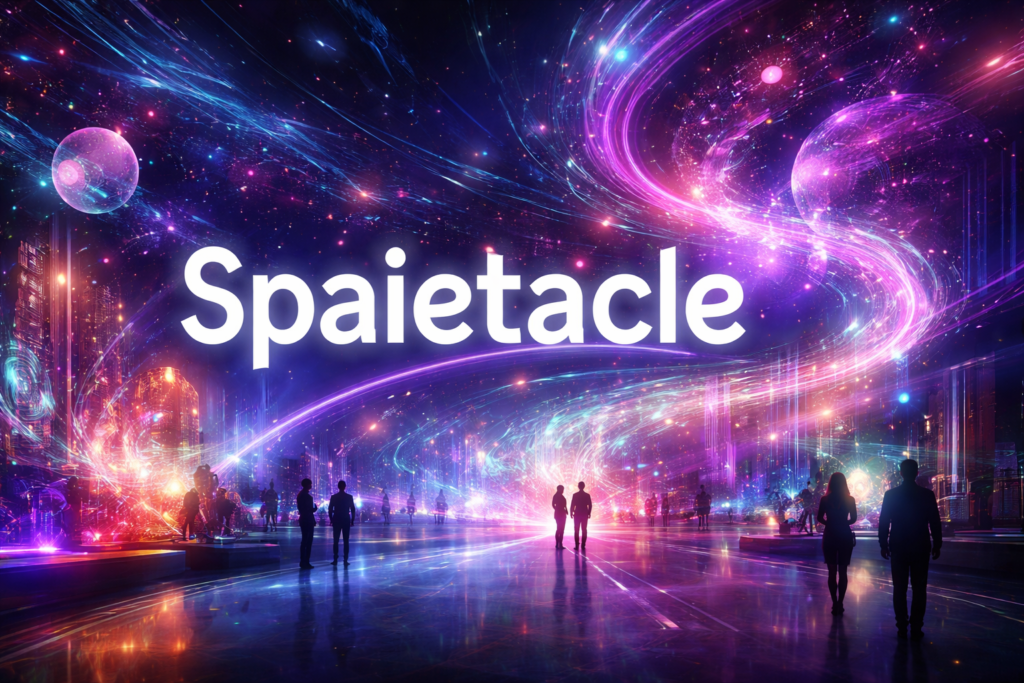
You won’t find Spaietacle in major dictionaries yet. That’s the first thing worth saying. Right now, it shows up mostly on newer websites and articles, and the meaning shifts a little from one source to another. Still, a pattern is easy to spot: most writers use Spaietacle to describe an experience that blends space, design, storytelling, and spectacle into something memorable, immersive, and emotionally engaging. Some also use the name for a multi-topic blog platform called Spaietacle.com.
So… what does that mean in plain words?
It means Spaietacle is less like a strict technical term and more like a modern creative idea. It usually points to experiences that don’t just work, but also feel impressive. Think of a museum room that reacts to movement, a digital product that feels personal and dynamic, or a branded event that people remember long after it ends. Recent articles connect the word to “space” plus “spectacle,” while standard dictionaries define spectacle as something striking, dramatic, or eye-catching.
A simple way to understand Spaietacle
Spaietacle sits somewhere between creativity and experience design.
It is not just decoration. And it is not just function either. It’s that middle area where a place, screen, brand, or event is designed to create a reaction — surprise, curiosity, delight, even a little wonder.
Quick breakdown
| Part | What it usually means |
|---|---|
| Space | A physical room, digital platform, website, AR layer, or environment |
| Art | Visuals, sound, movement, storytelling, design choices |
| Spectacle | The dramatic, memorable, attention-grabbing effect |
| Result | An experience people notice, feel, and remember |
That idea matches how several recent articles describe it: a fusion of space, art, spectacle, or spatial intelligence with emotional engagement in both digital and physical environments.
Why Spaietacle matters now
A big reason this word is getting attention is simple: people are tired of flat experiences.
Websites that only “work” are no longer enough. Stores that only “sell” feel forgettable. Events that only “inform” fade fast. Recent writing around Spaietacle argues that audiences now expect interaction, emotional connection, and some sense of immersion — whether they are online, in a gallery, at a product launch, or using software.
And honestly… that feels true.
People remember what they felt, not just what they clicked.
Common uses of Spaietacle
Here are a few areas where the concept fits really well:
- Web design
A site that uses motion, storytelling, layered visuals, and smooth interaction to guide attention. - Brand experiences
Pop-up events, launches, and product showcases that feel theatrical but still meaningful. - Museums and exhibitions
Interactive displays, light-based rooms, projection art, and motion-triggered storytelling. - Retail and ecommerce
Shopping spaces or product pages that create mood, not just transactions. - Education
Learning experiences that mix visuals, interaction, and emotional engagement.
Recent articles explicitly mention museums, science centers, festivals, ecommerce, and adaptive digital products as examples of how this kind of experience can work in real life.
Spaietacle as a website name
There’s another angle too.
Spaietacle.com presents itself as a blog platform covering topics like technology, lifestyle, creativity, wellness, and tips. So in some cases, the keyword “Spaietacle” may refer not to the concept, but to that specific content website.
That matters for SEO and content writing. Because if someone searches the word, they may be looking for:
- the meaning of the concept
- the website itself
- an article explaining the trend
- or a general brand/tech interpretation
So context matters… a lot.
What makes something feel like Spaietacle?
Usually, it has a few ingredients:
- A strong sense of place
- Visual or emotional impact
- Storytelling, even if subtle
- Audience interaction
- A memorable “moment”
But it doesn’t have to be huge or expensive. That’s the nice part. A well-designed landing page can feel like Spaietacle. A creative showroom can too. Even a small event corner with light, sound, and mood can carry that same energy.
Final thoughts
Spaietacle is still a fresh, evolving word. It is not a fixed dictionary term, and different sites explain it in slightly different ways. But the core idea stays pretty consistent: it’s about turning ordinary spaces or digital experiences into something more vivid, interactive, and memorable.
And maybe that’s why people are drawn to it.
Because in a noisy world, plain functionality isn’t always enough. People want meaning. Atmosphere. A story. Something that feels a little bigger than the screen in front of them.
That’s where Spaietacle comes in.