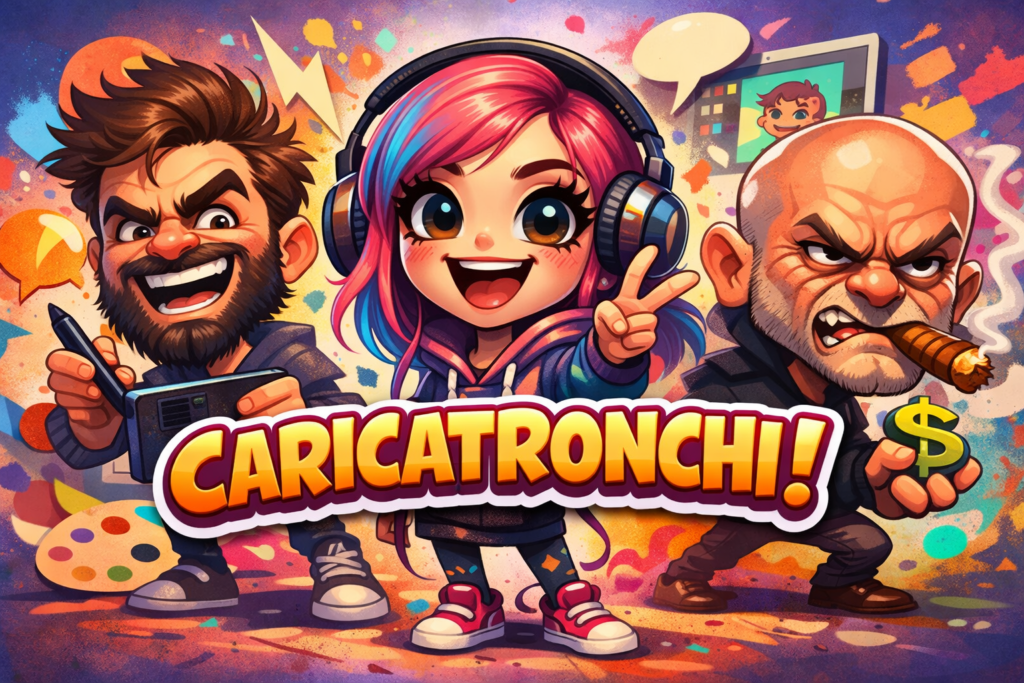
Some words feel polished right away. Others arrive a little strangely… and that’s exactly why people remember them.
Caricatronchi is one of those words. It’s being used online to describe a visual style that mixes exaggeration, personality, cartoon energy, and digital creativity. Not a stiff art-school label. More like a living internet term that’s still stretching into its meaning. And honestly, that makes it interesting.
At its core, caricatronchi seems to blend the idea of caricature—art that exaggerates features on purpose—with a more fragmented or stylized visual approach. Traditional references define caricature as a funny or exaggerated representation of someone, while recent articles on caricatronchi describe it as more emotional, expressive, and often more digital than old-school caricature. The result isn’t always just humor. Sometimes it’s identity, mood, storytelling… even a bit of attitude.
And the name itself adds to that feel. Several sources connect the second half of the word to the Italian tronco/tronchi, which can refer to a trunk or something truncated, cut, or reduced. That does fit the style people describe online: simplified forms, warped proportions, broken-up shapes, and a look that values impact over realism. Not perfect likeness. Stronger expression.
A Simple Way to Understand Caricatronchi
If regular portrait art says, “Here is exactly what this person looks like,” caricatronchi says, “Here is what this person feels like.”
That’s the difference. A bigger grin. Sharper eyes. A tiny body with a huge expressive head. Bold lines. Bright color. Cartoon logic. Sometimes playful, sometimes weird, sometimes surprisingly deep. A few recent explainers even frame it as a style tied to digital identity—how people present themselves online, not just how they appear in real life.
Caricatronchi vs Traditional Caricature
| Feature | Traditional Caricature | Caricatronchi |
|---|---|---|
| Main goal | Exaggerate looks, often for humor | Express mood, identity, and style |
| Usual feel | Funny, satirical, quick-read | Playful, emotional, more layered |
| Visual approach | Facial exaggeration | Exaggeration plus stylized or fragmented forms |
| Common medium | Hand-drawn or live sketching | Mostly digital art and online sharing |
| Best use | Humor, souvenirs, satire | Avatars, branding, creative storytelling |
This comparison reflects the pattern repeated across current web articles: caricature is the foundation, but caricatronchi pushes further into digital self-expression and visual storytelling.
Why People Are Talking About It
Part of the appeal is simple — it grabs attention fast.
We live on screens. Feeds move quickly. Plain visuals disappear. But exaggerated art with personality? That sticks. Recent articles repeatedly connect caricatronchi to social media visibility, digital tools, online communities, and branding because expressive visuals are easier to notice and remember than flat, generic images. And yes, that makes sense. A strange face with charm will usually beat a boring profile picture.
Some common uses mentioned online include:
- profile images and avatars
- creative branding and mascots
- digital illustrations
- character design
- social content that needs a bold visual hook
- playful storytelling art
These use cases show up again and again in recent articles about the term, especially where identity, engagement, and visual memorability matter.
What Makes the Style Work
A few qualities show up across most descriptions:
- Exaggeration that highlights personality, not just appearance
- Emotion-first design so the image feels alive
- Simplified or distorted shapes for clarity and impact
- Digital flexibility because artists can experiment fast
- Storytelling energy instead of plain portrait realism
But here’s the thing… caricatronchi still feels loose as a term. It isn’t locked into one official rulebook. That’s probably why it’s spreading. Artists, bloggers, and designers seem to be using it as a flexible label for expressive, caricature-inspired digital art that feels modern and a little unconventional.
Final Thoughts
Caricatronchi matters because it captures something very current. People don’t just want images anymore. They want identity. Personality. Mood. Something that says more in one glance.
So, whether you see it as a new art style, a digital branding trick, or just a fun extension of caricature, the idea is pretty clear: bend reality a little, and sometimes the truth shows up better. And maybe that’s why the term keeps surfacing online. It feels messy, creative, internet-native… and oddly human.