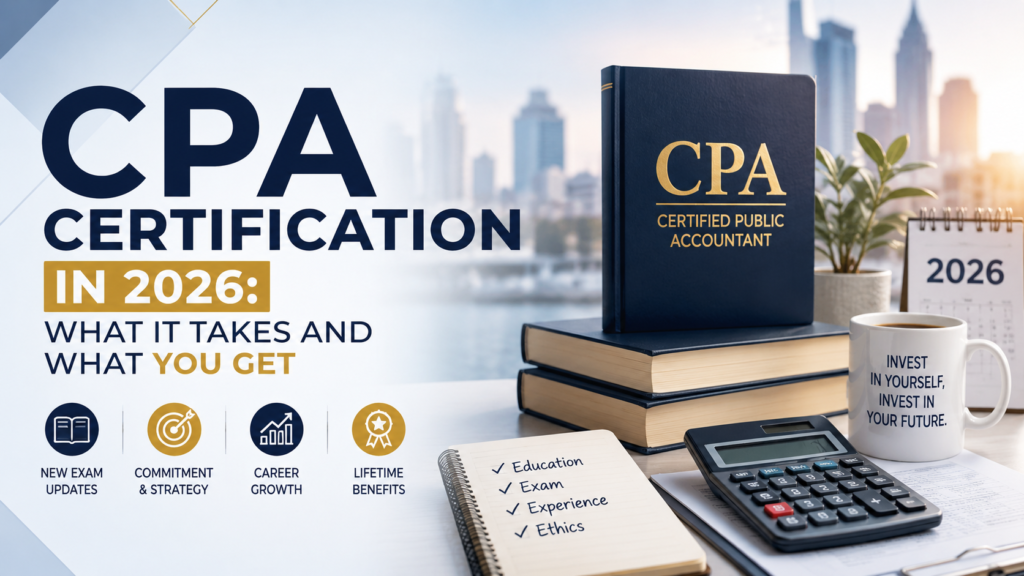
Most accounting students hear about the CPA early in their degree. But very few actually sit down and map out what the full process looks like before they start. The exam has changed, the job market has shifted, and the salary numbers from five years ago are no longer accurate. This article covers what getting CPA certified actually looks like in 2026, from eligibility to earnings.
Who Can Appear for the CPA Exam
The CPA certification is issued by individual state boards across the United States, and while requirements vary slightly by state, the general framework is consistent.
To qualify, you need a bachelor’s degree with coursework in accounting and business. Most states also require 150 semester credit hours in total, which is 30 more than a standard four-year degree covers. Candidates typically fill this gap through a master’s degree in accounting or an additional year of coursework.
Work experience is part of the picture too. Most states ask for one to two years of verified experience under a licensed CPA before they issue the actual license, even after you pass the exam.
The Exam Format in 2026
The AICPA restructured the CPA exam in early 2024, and that format continues into 2026. The new model divides the exam into core sections and one discipline section of your choice.
Core sections (mandatory for all candidates):
| Section | What It Covers |
| FAR – Financial Accounting and Reporting | GAAP, nonprofit accounting, government financials |
| AUD – Auditing and Attestation | Audit procedures, ethics, internal controls |
| REG – Regulation | Federal tax law, business law, ethics |
Discipline sections (pick one):
| Section | Focus |
| BAR – Business Analysis and Reporting | Advanced financial reporting and analytics |
| ISC – Information Systems and Controls | IT audit, data security, system reliability |
| TCP – Tax Compliance and Planning | Individual and entity tax planning |
Each section runs four hours. Total exam time across all four sections is 16 hours.
Once you pass your first section, you have 18 months to pass the remaining three. Any section passed outside that window needs to be retaken.
Pass Rates for 2025 (Most Recent Available)
These numbers from AICPA data give a realistic sense of where candidates struggle most:
| Section | Pass Rate |
| FAR | Around 44% |
| AUD | Around 48% |
| REG | Around 60% |
| BAR | Around 59% |
| ISC | Around 71% |
| TCP | Around 64% |
FAR has the lowest pass rate because of how much ground it covers. Candidates who underestimate it tend to go in underprepared. Most people studying for all four sections spend somewhere between 300 and 400 hours total.
What It Costs to Get CPA Certified
Here is a realistic cost breakdown for 2026:
| Expense | Estimated Cost (USD) |
| Exam fees across all 4 sections | $1,000 to $1,500 |
| Review course | $1,500 to $3,500 |
| State application and licensing fees | $200 to $500 |
| Ethics exam | $150 to $250 |
Total spend usually falls between $3,000 and $6,000 depending on your state and which review course you go with. Some employers reimburse part of this, especially at larger firms.
Salary After CPA Certification
The pay gap between CPA holders and non-licensed accountants is real and it shows up early in a career.
| Role | Salary Range (USD) |
| Staff Accountant without CPA | $55,000 to $70,000 |
| Staff Accountant with CPA | $70,000 to $90,000 |
| Senior Accountant | $90,000 to $115,000 |
| Audit Manager | $115,000 to $145,000 |
| Controller or CFO | $150,000 and above |
AICPA workforce data shows CPA professionals earning 10 to 15 percent more than peers at similar experience levels. That gap grows wider at the manager and director level.
Where CPAs Are Actually Getting Hired in 2026
Public accounting firms still hire the most CPAs, but the field has spread out considerably. In 2026, strong demand is coming from:
- Technology companies dealing with revenue recognition and compliance
- Healthcare systems managing audits and financial reporting
- Financial services firms needing risk and audit oversight
- Government agencies and public sector organizations
- Advisory and forensic accounting practices
The Bureau of Labor Statistics projects accounting jobs to grow by 6 percent through 2033, with licensed roles growing faster than the overall category.
Is the CPA Worth Pursuing in 2026
The numbers make a reasonable case on their own. Higher starting salary, faster promotions, and a credential that carries weight across industries and geographies. The CPA certification does not expire as long as you keep up with continuing education, which most states set at 40 hours per year.
The harder question is timing. Candidates who plan their 150 credit hours early, choose their discipline section based on actual career goals, and give themselves enough study time tend to clear the exam in 12 to 18 months.
For students working through the education and preparation side of things, Zell Education has programs built specifically around the CPA path, covering both the academic requirements and exam readiness.