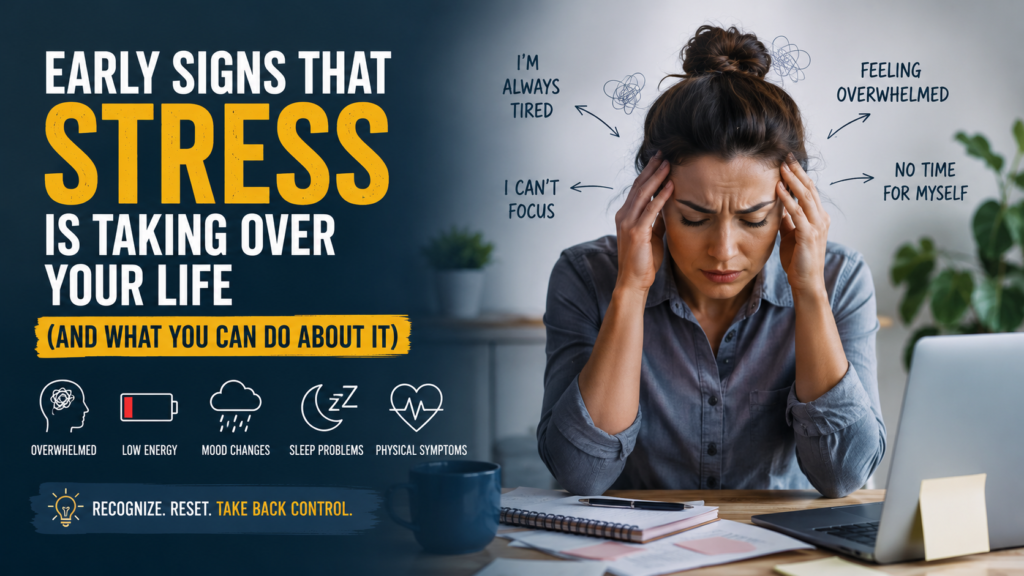
For about eight months, I had a headache almost every day at around 4 pm. I blamed my screen, then my glasses, then dehydration. I bought a water bottle with the hours marked on the side. The headaches didn’t care.
What was actually happening, and I only see this looking back, was that I’d taken on too much and my body had started billing me for it. Nobody sat me down and told me I was stressed. I probably wouldn’t have listened anyway. I thought stressed people were the ones crying in stairwells, and I was just tired.
Turns out that’s how it goes for most people. Stress doesn’t kick the door in. It moves in slowly, and it’s very good at convincing you that everything it’s doing to you is just normal life.
The physical signs
Your body usually knows before you do. Mine picked up headaches. For other people, it’s a jaw that’s sore in the morning from clenching all night, or a stomach that’s suddenly unreliable, or catching every single bug that goes around when you never used to.
There’s actually a long history behind this idea. In the 1930s, a researcher called Hans Selye took the word “stress” from engineering, where it meant the load that eventually makes a material fail. He conducted experiments on laboratory animals and found that all kinds of different pressures produced the same physical wear. The specifics have been argued over since, but the basic point held up: sustained pressure shows up in the body, whether you acknowledge it or not.
The mistake I made, and I think it’s a common one, was treating each symptom separately. Painkillers for the head, antacids for the stomach. If you’re doing the same thing, it might be worth asking whether all these little complaints have one cause.
The mental signs
These are harder to spot because you’re using the same brain that’s affected to do the spotting.
Concentration usually goes first. I remember reading the same paragraph of a report three times and still not knowing what it said. Small decisions get strangely difficult too. And things you used to look forward to start feeling like obligations, which is a bad sign that’s easy to explain away.
Irritability is the one other people will notice before you do. If someone close to you has asked what’s going on with you lately, don’t brush it off. My wife asked me that twice before I paid any attention, and she was right both times.
And sleep. Either you can’t get to sleep, or you wake at three in the morning already worrying about the day ahead. That 3am wake-up is so common it’s almost a cliché among GPs.
What actually helped
I’ll skip the usual advice about candles and just tell you what worked, for me and for people I know who’ve been through worse.
Saying it out loud came first. There’s a real difference between vaguely feeling rubbish and actually saying “I’m stressed and it’s causing problems.” One is weather. The other is a problem you can work on.
Then I wrote down what was causing it. Sounds pointless, but “everything” turned out to be three things, and one of them I could hand off within a week. The other two I couldn’t change, but even knowing that helped, because I stopped wasting energy pretending I could.
Walking helped more than I expected. Not exercise as a project, just twenty minutes outside without my phone most days. The science on this is fairly solid, something about physical movement using up the stress hormones your body keeps producing, but honestly I didn’t need the science. I could feel the difference within a fortnight.
The other thing, and I resisted this longer than I should have, is getting proper help. A friend of mine went to Pinnacle Therapy after her divorce, when the stress had built up to the point where the walks and the lists weren’t touching it, and she says the biggest surprise was how practical it was. Less lying on a couch, more getting a complete guide to stress management that actually fit her situation. She wishes she’d gone a year earlier. Everyone who goes seems to say that.
Where that leaves you
I still get the 4 pm headache occasionally. The difference is that now I know what it means. It’s not a screen problem or a glasses problem, it’s a warning light, and when it comes back, I look at my week and figure out what I’ve overloaded.
That’s about the most useful thing I can pass on. Learn what your own warning lights are, the headache or the short temper or the 3 am ceiling-staring, and take them seriously early, while the fixes are still small. If the small fixes aren’t enough, somewhere like Pinnacle Therapy can put together a complete guide to stress management around your actual life, and there’s no shame in that. Waiting until you’re in real trouble is the only genuinely bad option, and I say that as someone who tried it.