 By Admin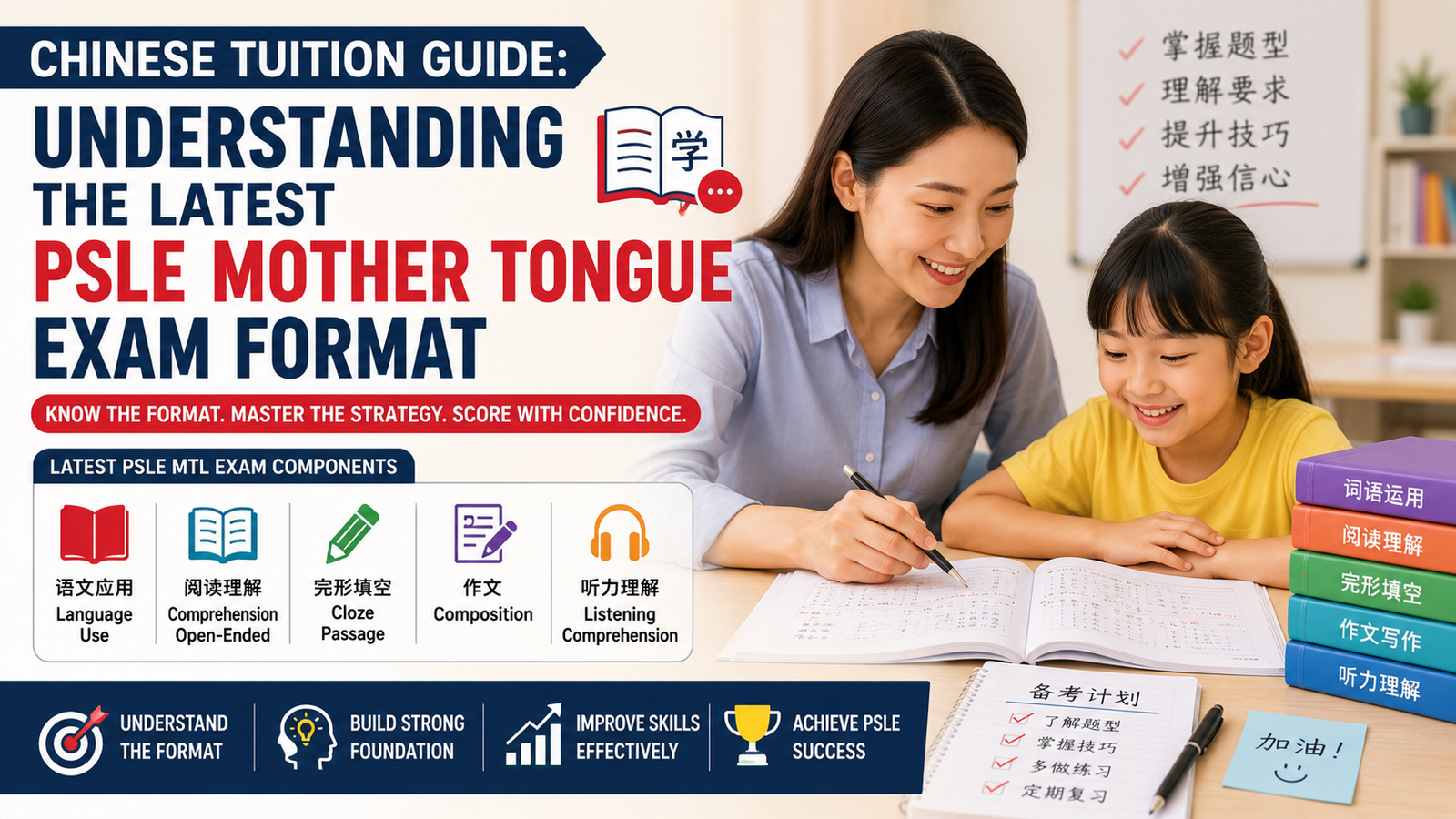
The Primary School Leaving Examination (PSLE) is one of the most significant milestones in Singapore’s education journey. For many families, Mother Tongue is a subject that requires consistent effort and careful preparation. As the examination format continues to evolve to better assess practical language skills, parents are increasingly turning to Chinese Tuition to help their children build confidence and improve performance.
Understanding the latest PSLE Chinese examination format is essential for both students and parents. With the right study strategies, regular practice, and guidance from experienced educators, students can strengthen their language abilities while preparing effectively for every section of the examination.
Why Understanding the Latest PSLE Chinese Exam Format Matters
The Ministry of Education (MOE) has refined the PSLE Chinese examination over the years to place greater emphasis on real-life communication, critical thinking, and language application rather than simple memorisation.
Students are now expected to:
- Apply vocabulary naturally in different situations.
- Demonstrate strong reading comprehension.
- Express ideas clearly in writing.
- Listen carefully and interpret spoken information accurately.
- Communicate confidently during oral examinations.
This shift encourages students to develop genuine language proficiency instead of relying solely on repetitive learning techniques.
Overview of the Latest PSLE Chinese Examination
The PSLE Chinese examination consists of several components that assess different language skills.
| Examination Component | Skills Assessed |
| Paper 1 | Situational Writing and Continuous Writing |
| Paper 2 | Language Use and Reading Comprehension |
| Listening Comprehension | Understanding spoken Chinese |
| Oral Examination | Reading aloud and conversation |
Each paper contributes to the student’s overall performance, making balanced preparation extremely important.
Paper 1: Developing Strong Writing Skills
Paper 1 evaluates a student’s ability to communicate ideas effectively through writing.
Students are required to complete:
Situational Writing
This section presents a practical scenario where students respond appropriately using the information provided.
Common examples include:
- Writing messages
- Giving recommendations
- Responding to invitations
- Sharing opinions
Students should learn how to identify key details and organise their responses logically.
Continuous Writing
Students choose from several picture-based compositions.
Success depends on:
- Understanding the theme accurately
- Using suitable vocabulary
- Creating a clear storyline
- Including meaningful descriptions
- Demonstrating correct grammar and sentence structure
Regular composition practice helps students become more creative and confident writers.
Paper 2: Strengthening Language Application
Paper 2 focuses heavily on understanding and applying the Chinese language correctly.
Students are tested on:
- Vocabulary usage
- Grammar
- Sentence structure
- Reading comprehension
- Contextual understanding
Rather than memorising answers, students must analyse passages carefully before selecting the most suitable responses.
Parents often notice that comprehension sections become increasingly challenging because questions require students to infer meanings instead of locating direct answers.
Listening Comprehension: Paying Attention to Detail
Listening Comprehension measures how well students understand spoken Chinese.
Recordings are played only once or twice, making concentration extremely important.
Students should practise:
- Listening for key information
- Identifying important details
- Understanding tone and context
- Managing examination timing
Daily exposure to Chinese through conversations, educational videos and audio recordings can gradually improve listening abilities.
Oral Examination: Building Communication Confidence
The Oral Examination has become one of the most important components of the PSLE Chinese paper.
Students are assessed through:
Reading Aloud
This evaluates:
- Pronunciation
- Fluency
- Accuracy
- Expression
Stimulus-Based Conversation
Students discuss a given visual stimulus while expressing opinions and sharing personal experiences.
Examiners look for:
- Natural communication
- Clear pronunciation
- Appropriate vocabulary
- Logical thinking
- Confidence
Practising conversations regularly helps students respond more naturally during the examination.
Common Challenges Faced by Students
Many students encounter similar obstacles while preparing for PSLE Chinese.
These include:
- Limited vocabulary
- Difficulty understanding comprehension passages
- Lack of confidence during oral examinations
- Weak composition planning
- Incorrect grammar usage
- Poor time management
Recognising these challenges early allows parents and teachers to provide targeted support before examination season begins.
How Chinese Tuition Supports PSLE Success
Many families choose Chinese Tuition because personalised guidance allows students to focus on areas requiring improvement.
Quality tuition programmes typically provide:
- Structured lesson plans
- Regular assessment practices
- Individual feedback
- Exposure to examination-style questions
- Composition writing guidance
- Oral conversation practice
- Vocabulary enrichment activities
Students also benefit from learning strategies that are difficult to acquire through independent study alone.
Effective Study Strategies for Students
Preparing for PSLE Chinese should involve consistent practice rather than last-minute revision.
Some effective approaches include:
- Read Chinese storybooks and newspapers regularly.
- Learn a few new vocabulary words every day.
- Practise composition writing weekly.
- Review mistakes from previous worksheets.
- Speak Chinese during family conversations whenever possible.
- Complete timed practice papers.
- Record oral responses to improve pronunciation.
Small daily improvements often lead to significant progress over time.
How Parents Can Support Learning at Home
Parents play an important role in creating a positive learning environment.
Simple ways to help include:
- Encouraging children instead of focusing only on marks.
- Setting a consistent revision schedule.
- Reading Chinese books together.
- Watching Chinese educational programmes.
- Practising conversations during meals.
- Celebrating improvements, no matter how small.
A supportive home environment helps children develop confidence and enjoy learning the language.
Choosing the Right Tuition Programme
Not every tuition programme suits every learner.
Parents should look for centres that provide:
| Feature | Why It Matters |
| Small class sizes | More personalised attention |
| Experienced teachers | Better understanding of examination requirements |
| Regular assessments | Tracks learning progress |
| Comprehensive materials | Covers every examination component |
| Oral practice opportunities | Builds communication confidence |
| Constructive feedback | Helps students improve continuously |
Selecting a programme that matches the student’s learning style can make preparation more effective.
Supporting Students Throughout Their Learning Journey
As students progress through primary school, consistent guidance becomes increasingly valuable. Many parents appreciate structured learning environments where teachers can identify weaknesses early and adjust lessons accordingly.
Established education providers such as Mavis Tutorial Centre offer programmes that reinforce classroom learning and help students prepare for examinations through systematic practice and individualised support. Combined with regular revision at home, such guidance can help students approach the PSLE with greater confidence and stronger language skills.
Final Thoughts
The latest PSLE Mother Tongue examination places greater emphasis on practical communication, comprehension, and critical thinking. Understanding the examination format allows students to prepare strategically while developing genuine proficiency in Chinese.
Consistent practice, positive encouragement, and quality Chinese Tuition can help students strengthen every component of the examination, from composition writing to oral communication. With the right preparation, students can build confidence, improve their language abilities, and perform to the best of their potential on examination day.
For parents seeking additional learning support and structured preparation, visit mavistutorial.com to explore programmes that can help students achieve greater success in Chinese learning.