You know how mobile apps used to be simple?
Like one app = one job.
Music here. Videos there. Reading somewhere else.
It was fine… until it wasn’t.
Because now people don’t really use phones that way anymore. Everything overlaps. You watch something while half-listening to something else. You read a bit, then switch to audio because you’re busy. Or you just scroll without even thinking about format.
And that’s kind of where this idea of application mobile dualmedia quietly fits in.
Not loudly. Not as some big revolution. More like a natural shift.
So what is this thing really?
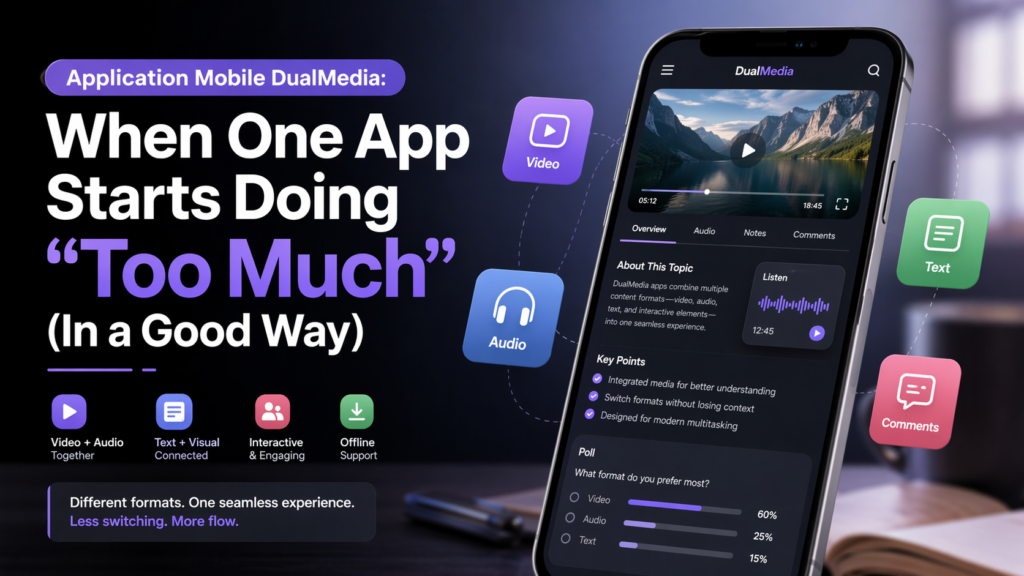
If we strip away the fancy name, it’s basically just an app that mixes different media types in one place.
That means:
- video + audio together
- text that connects with visuals
- sometimes interactive stuff mixed in
- all inside one app, not separated tools
It’s not trying to reinvent the wheel. It’s just combining things people already use… and making it less annoying to switch around.
And yeah, that “switching around” part is the key problem it tries to fix.
Why are people even building apps like this?
Simple answer: because users are impatient now.
Nobody really wants to jump between 4 different apps just to finish one idea.
Like imagine this:
You’re watching something → then you want details → then you want audio → then maybe comments.
Normally, you’d leave the app, open something else, search again… kind of tiring if you think about it.
Dualmedia apps try to keep everything inside one flow.
Not perfect. But smoother.
What does a dualmedia app usually include?
It depends on the app, but most of them share a few common things:
- Videos that connect with text explanations
- Audio versions of visual content
- Interactive sections (polls, comments, quizzes)
- Smooth switching without reloading everything
- Sometimes offline support so content still works without internet
And the interesting part is, users don’t always notice they’re switching formats. It just feels like one continuous experience.
That’s the goal anyway.
Where you already see this (without realizing it)
You might think this is some new concept, but it’s already everywhere in small pieces.
For example:
- A video that has captions + description + comments
- A learning app that shows video and notes together
- A social app where posts include text, voice, and clips
- Streaming platforms adding live chat during videos
Nothing is fully “dualmedia” in a perfect sense… but a lot of apps are slowly moving in that direction.
It’s more like evolution than invention.
A simple comparison
Just to make it clearer:
| Normal apps | DualMedia-style apps |
|---|---|
| One type of content | Multiple formats together |
| You switch apps often | You stay in one place |
| Separate experience | Connected experience |
| Simple but limited | Rich but more complex |
So yeah, it’s not just a feature upgrade. It’s a different way of thinking about apps.
The part people don’t talk about much
It sounds great on paper, but it’s not always easy.
Because once you start mixing media types, things get heavier:
- apps can become slow if not optimized well
- design gets more complicated
- developers have to manage multiple content systems
- user experience can get messy if overdone
So there’s always this balance issue… keep it powerful, but don’t make it confusing.
Some apps do it well. Some don’t.
Why users actually like it
Even with all the complexity, people still prefer it when done right.
Because it feels:
- less repetitive
- more flexible
- more “one-stop”
- easier for multitasking
And honestly, users don’t care about the technical side. They just want things to work without friction.
If an app lets you do more without thinking too much, people stick with it.
Where this might go next
If things continue like this, apps might stop being “single-purpose” altogether.
Instead of:
- one app for video
- one for audio
- one for reading
You’ll just have a few big platforms that handle everything depending on how you want to consume it at the moment.
And with smarter systems (AI is already creeping in here), apps might even adjust automatically:
- you’re busy → audio mode
- you’re focused → text mode
- you’re relaxing → video mode
That’s not far away. It’s already starting in small ways.
Final thoughts
Application mobile dualmedia isn’t really about technology sounding advanced.
It’s more about convenience catching up with human behavior.
We don’t consume content in neat categories anymore. Everything overlaps. Everything mixes.
So apps are slowly doing the same.
Not perfectly. Not suddenly.
Just gradually becoming less separated… and more blended.
And maybe that’s the real point of it.
Not complexity.
Just… less friction.
Want to read more like this? Check out novapg for more interesting articles.