 By Admin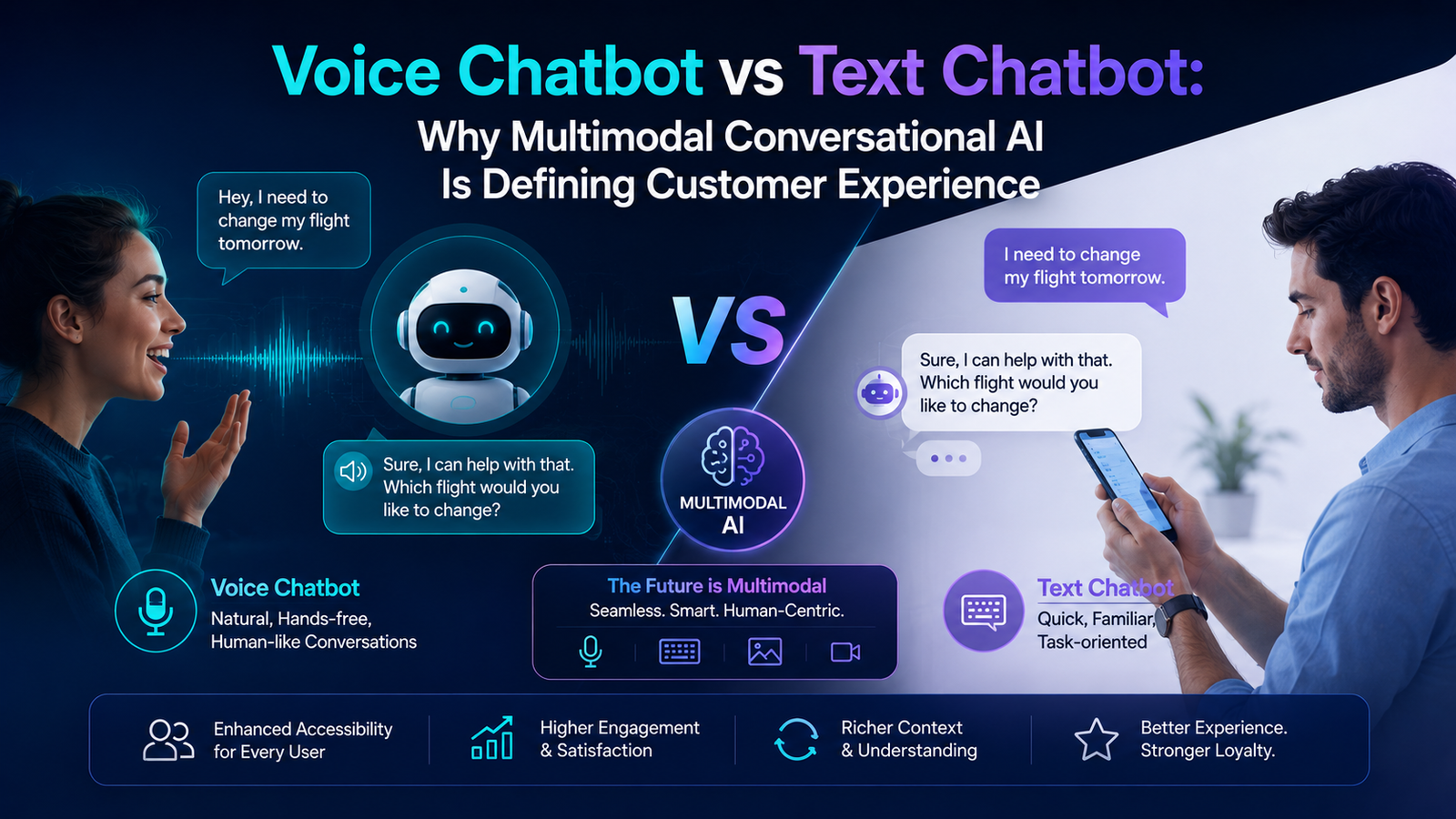
For years, businesses framed automation around a simple choice: should customers speak to a bot or type to one? That question no longer captures what is happening in modern service environments. The real shift is not toward one winning interface. It is toward systems that understand when a conversation should happen through voice, when text is more effective, and when both should work together inside the same journey.
That is why the debate around voice chatbot vs text chatbot now belongs inside a larger discussion about customer experience design. Enterprises are not only buying automation. They are redesigning how support, sales, onboarding, and service recovery happen at scale.
The Comparison Has Become More Practical
A text-based chatbot still makes sense in many digital journeys. It gives customers room to read, pause, revisit details, and correct information without pressure. That matters when the interaction includes product terms, policy language, account updates, or troubleshooting steps that are easier to process on screen than through audio.
A voice chatbot performs differently. It works best when immediacy matters, when typing creates friction, or when the customer is already in a phone-first moment. Booking an appointment, checking a delivery status while driving, routing a service request, or handling a quick support need over a call are very different experiences from reading through a help flow on a website.
Seen through that lens, voice chatbot vs text chatbot is less about capability and more about fit. The better channel is usually the one that lowers effort in that specific moment.
Why Text Still Holds Its Ground
Text still matters because it gives people room to process information clearly. Customers can scan the options, revisit earlier replies, open links when needed, and move through the conversation at their own pace. In support settings, that often leads to better understanding and fewer repeated mistakes.
Text also fits business workflows that depend on documentation and follow-through. A customer updating billing details, comparing return conditions, or following installation steps often benefits from a written trail.
Text-based systems are especially effective when the journey involves:
- Visual guidance
- Layered information
- Asynchronous follow-up
- Lower deployment complexity
- Easier integration into digital support channels
That is why many conversational AI chatbots still begin with text. For a large number of routine tasks, it remains the most practical starting point.
Where Voice Changes The Equation
Voice is often more effective in moments where speed and natural flow matter more than visual structure. A spoken interaction can feel easier and more direct in high-intent situations because it removes the burden of typing, particularly when the customer wants a quick resolution rather than another page to navigate.
This matters in customer service, but it also matters in lead handling and operational triage. A business may gain more from voice when the goal is to qualify urgency, route calls intelligently, confirm details fast, or keep a live conversation moving toward resolution.
Voice can also surface something text often misses: tone. Frustration, hesitation, and urgency show up differently when a customer speaks. Used well, that can improve routing and escalation. Used poorly, it can make the experience feel rigid and frustrating. That is where design quality becomes decisive.
The Hidden Trade-Offs Businesses Often Miss
The weakest articles on this subject reduce the discussion to convenience. The stronger view is more demanding. Voice introduces transcription challenges, latency, accent variation, noise interference, and a narrower margin for error recovery. Once a customer misses a spoken answer, the interaction can become tiring very quickly.
Text has clear practical limits. It can feel too slow when a response needs to happen quickly, and it can add avoidable friction when customers would rather speak than type, especially on mobile or in high-pressure moments.
So the more useful question is not which format sounds smarter. It is which one handles the task with less strain, fewer breakdowns, and better continuity if the interaction needs to move to a human agent.
Why The Future Is Multimodal
This is where the market is clearly heading. Businesses are discovering that the highest-performing systems do not force every interaction into one channel. They build fluid movement between them.
A customer may begin with voice to explain a problem quickly, receive a text summary with links or confirmations, and continue with a live agent who already has the full context. That kind of journey feels more natural because it matches how people actually communicate.
In that environment, voice chatbot vs text chatbot stops being a binary choice. It becomes a planning decision within a broader customer strategy. The winning model is not voice-only or text-only. It is multimodal, context-aware, and designed around the work the customer is trying to complete.
What Businesses Should Prioritize Now
Enterprises evaluating automation should look beyond novelty and ask harder questions. Which interactions need speed? Which need clarity? Which carry emotional sensitivity? Which should stay automated, and which should escalate with context intact?
Those decisions shape experience quality far more than the interface alone. They also determine whether automation reduces pressure on teams or simply shifts frustration to another channel.
The most effective programs will be built with that level of discipline, supported by thoughtful design, strong orchestration, and the right artificial intelligence software development services behind the scenes.
As customer expectations keep rising, the businesses that win will not be the ones chasing one channel over another. They will be the ones building conversational systems that know when to speak, when to write, and when to hand over gracefully. That is the kind of work Pattem Digital helps bring to life.